
What a Website Footer Says About Your Small Business

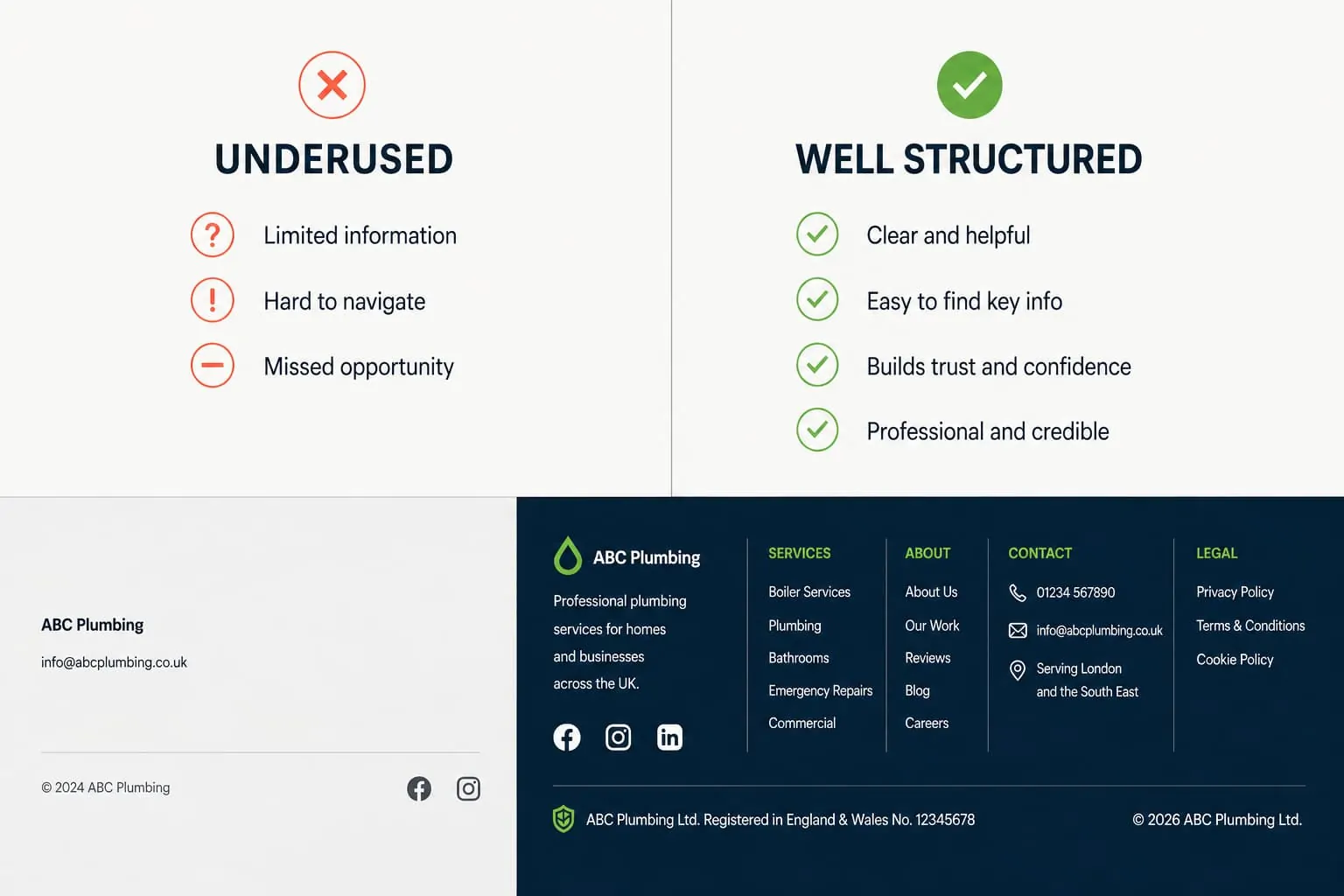
The website footer is one of the most consistently visible parts of any small business website, yet it is often given the least attention.
For many UK businesses, it is also one of the most overlooked opportunities to build trust and guide visitors. When did you last review yours?
Positioned at the bottom of every page, it is easy to treat as a holding area for basic details. In practice, it carries more weight than many business owners realise. It is seen repeatedly, often used as a shortcut for key information, and forms part of the final impression a visitor takes away.
In this article
- Why the website footer matters
- How visitors actually use it
- What to include in a small business website footer
- How to improve it without a full redesign
The Footer as a Decision Point
Website journeys are rarely linear. Visitors do not always move from the homepage through to a contact page in a structured way. Most scan, skip, and jump between sections. One consistent behaviour is the tendency to scroll straight to the bottom of a page. This is where visitors often look for confirmation. They expect to find contact details, supporting links, and signals that the business is legitimate. In this context, the footer becomes more than a design feature. It acts as a checkpoint.
If the information is clear and complete, it reinforces confidence. If it is limited or unclear, it can introduce hesitation.
A Common Pattern Across Small Business Websites
Many small business websites follow a similar pattern when it comes to the footer. The content is minimal, often limited to a business name and a single method of contact.
In many cases, there is a significant amount of unused space. This is rarely intentional. It is simply an area that has not been developed as the rest of the site has evolved.
The result is a section that does very little to support the wider goals of the website.
- It does not guide visitors.
- It does not reinforce what the business does.
- It does not strengthen credibility.
For decision makers comparing several businesses, these small details can influence how complete and well managed a business appears.
What Should a Small Business Website Footer Include?
A well considered footer does not need to be complex. What matters is what it communicates at a glance.
A strong small business website footer should include:
- A short business description
A brief explanation of what the business does and who it serves, helping visitors quickly understand its focus.
- Clear navigation links
Links to key pages such as About and Contact, allowing users to continue their journey without scrolling back to the top.
- Accessible contact details
An email address, phone number, and location or service area presented clearly and consistently.
- Branding elements
A logo or brand identifier to reinforce recognition and consistency across the site.
- Business credentials
For UK limited companies, this may include Ltd status and a company registration number, along with any relevant accreditations.
- Legal information
A clearly visible Privacy Policy and any other required documentation.
The Role of the Footer in Search Visibility
The website footer also plays a supporting role in how a site is understood by search engines. While it is not a primary ranking factor, it contributes to overall structure and clarity. A consistent description, combined with internal links, helps reinforce the theme and focus of the business.
Because the footer appears across every page, it supports consistency, which is an important signal in how websites are interpreted. This is becoming increasingly relevant as search continues to evolve, with greater emphasis placed on structured, reliable information.
Perception at the Point of Exit
The footer often represents the final stage of a visitor’s interaction with a website. At this point, a decision has usually already been formed, but it can still be reinforced.
A well structured footer strengthens a positive impression. It confirms that the business is established, accessible, and clearly presented.
An underdeveloped footer can have the opposite effect. It may suggest that details have been overlooked or that the website is not actively maintained.
Even when this is not the case, perception still influences decision making. For small businesses operating in competitive sectors, these signals matter.
How to Improve Your Website Footer
Improving a footer does not require a full redesign. In most cases, it comes down to identifying what is missing.
If the footer does not:
- describe the business
- support navigation
- provide reassurance
then it is not contributing as it should.
Adding a small number of well chosen elements can significantly improve its effectiveness. The focus should remain on clarity, structure, and relevance rather than volume.
Summary
The website footer is a constant presence across every page of a small business website. It supports navigation, reinforces key information, and contributes to how the business is perceived. When it is underused, it leaves gaps in the overall presentation.
When it is structured effectively, it strengthens trust and supports user decision making. For UK small businesses, where attention to detail can influence outcomes, the footer represents a simple but valuable opportunity to present the business more clearly and confidently.


