
Why Brand Consistency Matters for Small Businesses


For small businesses operating in the UK, brand consistency is no longer a cosmetic consideration. It is a core part of how your business is understood, evaluated, and ultimately chosen.
Customers are making faster decisions than ever. They are comparing multiple businesses within minutes, often across several platforms, forming impressions based on what they see and how clearly it all aligns. In that environment, consistency becomes a signal of stability, professionalism, and trust.
Where Inconsistency Begins
Inconsistency rarely comes from neglect. More often, it is the result of growth or change that has not been fully reflected across every touchpoint.
A business may introduce a new service, reposition its offering, update its logo, or relocate to a new address. These are all positive developments. The issue arises when those changes are only partially implemented.
It is common to see:
- A website that reflects an older version of the business
- A Google Business Profile with outdated contact details
- Social media profiles using previous branding
- Directory listings describing services that are no longer central to the business
Individually, these may seem minor. Collectively, they create a fragmented picture that can confuse potential customers.
The Impact on Customer Decision Making
When a potential customer researches your business, they are not analysing it in depth. They are looking for clarity.
A typical journey may involve searching your business name, visiting your website, scanning reviews, and checking a social profile. This process happens quickly, and it is largely instinctive.
If the information they encounter is consistent, it reinforces confidence. If it is not, it introduces doubt.
For example, if a customer sees different logos across platforms, or conflicting addresses, it raises a simple but important question: which version of this business is accurate?
That moment of uncertainty is often enough to affect a decision. In competitive sectors, even small doubts can lead a customer to choose a business that appears more cohesive and reliable.
How Inconsistency Appears in Practice
To understand the effect more clearly, it helps to compare this to a physical environment.
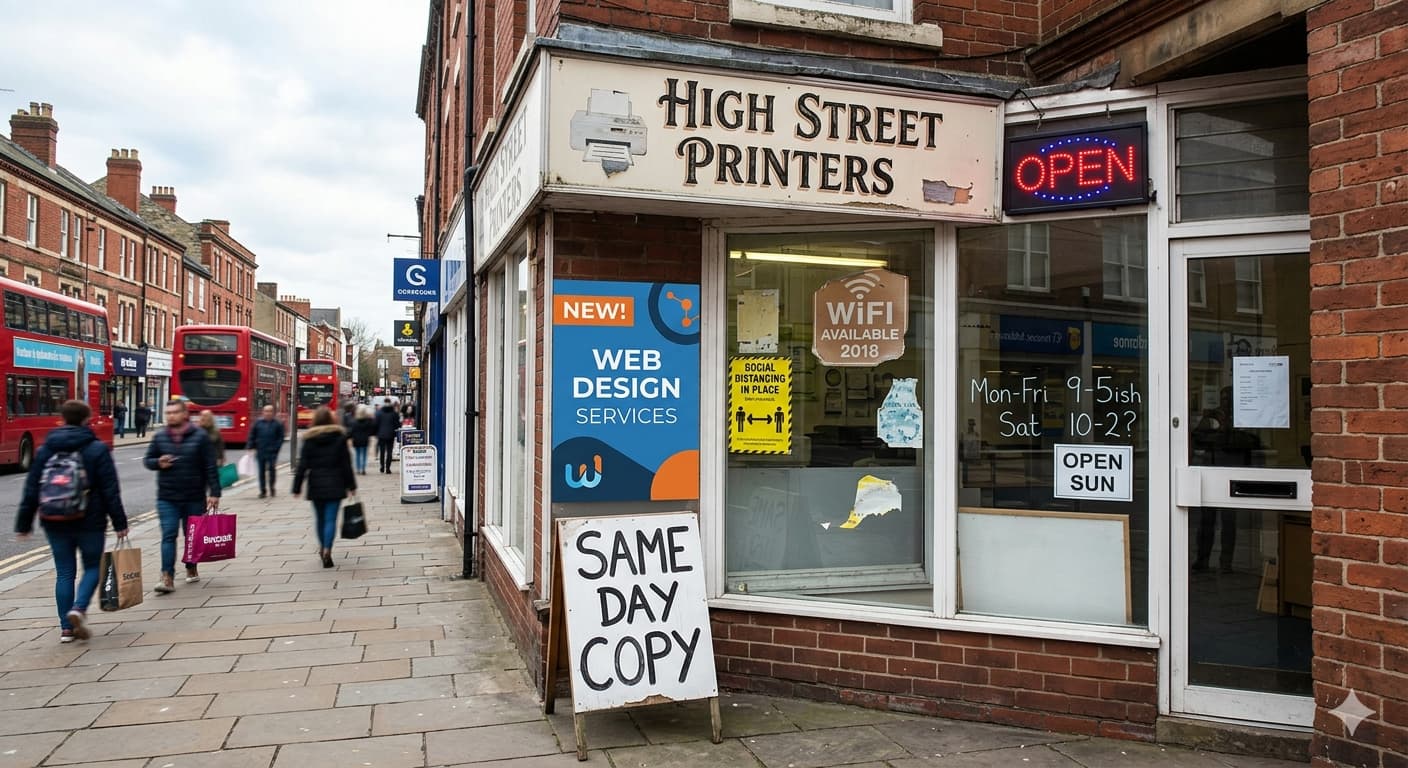
Imagine a business on a high street where the signage does not match the branding in the window, the opening hours are unclear, and there are outdated notices still displayed from several years ago. Perhaps there are still references to social distancing measures that are no longer relevant.
Even if the service itself is strong, the overall impression is one of poor upkeep and lack of attention to detail.
This is how inconsistency presents itself online. It signals that the business may not be actively managed, or that details are not being prioritised. Whether accurate or not, that perception matters.
The Role of Consistency in Search and Visibility
Consistency also plays a measurable role in how your business is interpreted by search engines and digital platforms.
Google, for example, looks for alignment across key business details such as name, address, and phone number. This is commonly referred to as NAP consistency and is a recognised factor in local search visibility.
Discrepancies across platforms can weaken the signals that search engines rely on to validate a business. Over time, this can affect how prominently your business appears in relevant searches.
This is explored in more detail in our article on the importance of NAP consistency for SEO, which outlines how even small inconsistencies can dilute your online presence.
Beyond traditional search, large language models and AI driven platforms are increasingly shaping how businesses are discovered. These systems aggregate information from multiple sources to form a unified understanding of a business.
If that information is inconsistent, it becomes more difficult for these systems to confidently present your business as a reliable option.
Messaging and Positioning Must Remain Aligned
Consistency extends beyond visuals and contact details. It also applies to how your business communicates its value.
Small businesses often expand their services over time. While this can be beneficial, it needs to be managed carefully from a messaging perspective.
If a business presents itself as a specialist but promotes a wide and unrelated range of services across different platforms, the positioning becomes diluted. Customers may struggle to understand what the business is truly known for.
Clear and consistent messaging helps customers quickly grasp what you do, who you help, and why they should choose you. Without that clarity, even a strong service offering can be overlooked.
Stability as a Trust Signal
In a digital environment where credibility must be established quickly, stability is a powerful differentiator.
A consistent brand suggests that a business is established, attentive, and actively maintained. It indicates that the business takes its presentation seriously and, by extension, is likely to take its service delivery seriously as well.
In contrast, inconsistency can suggest the opposite. It may imply that the business is disorganised, outdated, or lacking in attention to detail.
For small businesses without the backing of a widely recognised brand, these signals carry significant weight.
Summary
Brand consistency is not about rigidly maintaining the same identity indefinitely. It is about ensuring that any changes are implemented thoroughly and reflected across every platform where your business appears.
When your branding, messaging, and core details align, you make it easier for customers to understand your business and feel confident in their decision to engage.
When they do not, even small inconsistencies can introduce hesitation.
In a landscape where customers are making rapid, comparison driven decisions, that hesitation can be the difference between winning business and losing it.